SOME GREAT CAMPING GEAR THAT DIDN’T LAST

Updated: Jun 27
by Cliff Jacobson

What lasts depends upon consumer demand and price. Get these wrong and you have a loser, even if the product is great.
Here are some terrific camping products that didn’t survive the test of time:
1. The Cannondale Aroostook tent was designed by the Cannondale bicycle company around 1980. When I reviewed tents for Backpacker Magazine, I was so impressed with the Aroostook that I called the CEO of Cannondale and told him it was the best tent I had ever seen. I bought it immediately! Since then, I’ve used Aroostooks—and Aroostook copies—exclusively on all my trips. There are other excellent tents, but nothing quite compares to the Aroostook.

Here’s why: The fly and canopy are permanently connected, which encourages fast, dry set up in pouring rain. Two three-quarter inch diameter T6 aluminum, shock-corded poles and four stakes are all that’s needed for set-up and will hold the tent solid in winds of up to 30 miles an hour. Add six more stakes (total of nine) and the tent stands firm in winds above 60 mph. Our crew first used Aroostooks in 1983 on a 21-day canoe descent of the Hood River, which is located in northern Canada, just above the Arctic Circle. Our four tents weathered three days of continuous 62 mph wind, no problems. Yes, we had a wind gauge!


The Aroostook’s 6.5 x 7’ floor plan sleeps two comfortably, three in a pinch. Two more can sleep (a bit uncomfortably) in its twin, six-foot-long vestibules. One person can pitch the tent without help in less than three minutes, in a strong wind. Try that with any other three-person tent!
The Aroostook only lasted five years. Heading the list was cost. It sold for $325 in 1980, when other good tents were half the price. It’s strong catenary cut—which kept it drum tight under wind load, required precise stitching by accomplished sewers. A small mistake here and the tent didn’t’ work. Nylon shrinks over time and the poles became problematic. Poles that fit when new wouldn’t snap tight in the shrunken sleeves. Those in the know simply hacksawed off a quarter-inch of the pole ends and all was good again. For those who “didn’t know,” the tent was a failure. Cannondale could have corrected this flaw with grommet tracked webbing like that used on modern domes. But they didn’t. And the A-frame design was considered “old hat” by newbies who were enamored by domes.
Adendum: Long after its death, I lent one of my Aroostook’s to Gary McGuffin, one of Canada’s most famous wilderness canoeists, a writer/photographer, and environmentalist. Gary used the tent on several northern expeditions. He was so impressed that he pushed Eureka! Canada to re-make it. I sent Eureka! a detailed list of fixes and upgrades. But Eureka! didn’t listen. The resulting model (dubbed Eureka! Tundraline) was a superb tent, but at 12 pounds (the Aroostook weighed eight), it was too heavy and bulky for backpacking, canoeing, and bicycling, and too small for car camping. I asked Eureka! who their target buyers were? They didn’t reply. The Tundraline lasted one year then quietly went away.

2. Optimus 111B gasoline trail stove: Today’s campers rely on butane or propane stoves, which are ideal for the kind of “gentle” camping most people do. But for long trips in remote wilderness, white gas stoves still rule. And the best of the best is the ancient Optimus 111B, which burns Coleman fuel (naphtha). The 111B is extremely powerful, rugged, wind resistant and simple. Parts are brass and steel. The only non-metal part is the plastic adjustment wheel that controls the noisy “blowtorch” like flame. I’ve owned four 111B’s over the years and not one has been problematic, even when hammered hard for long periods of time.
111B’s were very expensive when new. Old used ones still are! In the late 1990’s, these stoves began to lose favor, so Optimus cheapened the design. They replaced the powerful geared jet-cleaning needle with a simple weighted one which was activated by a magnet. This worked well until the stove became very hot—as when frying fish for long periods of time. Then carbon buildup would seize the cleaning needle to the jet barrel. The wimpy magnet didn’t have enough power to clear the jet, so the stove froze up. Field repair was impossible. This “new and improved” 111B struggled on for a few years then died a quiet death.
3. TRAILWISE SLEEPING BAGS: In his classic book, The Complete Walker, author Colin Fletcher recommended Trailwise (Berkely, CA) camping equipment. Fletcher wasn’t blowing smoke: Everything Trailwise was top notch!
I currently have six down sleeping bags from four different manufacturers. They’re all good bags, but my two Trailwise mummy bags are my favorites. Beyond the superb build, It’s the big number 10 chain zippers that stand out. When you’re zipped inside and you need to exit fast, just swish the zipper pull, and in seconds, the bag flies open. No hesitation, no jams. Not ever! Try that with the little zippers on today’s sleeping bags. They jam and jam and jam, and keep jamming until you scream! Why such small zippers? To save a few ounces—and backpackers buy on ounces! But if, for some reason (a fire, or a bear is clawing at your tent)—and you need to exit fast, good luck. You won’t!
Rant: One of my sleeping bags is an expensive, three-season model made by a renowned company. I could not live with the constantly jamming zipper, so I returned it to the company for repair. They called and said it was “fine.” I asked if they had crawled inside the bag then tried it? The answer was “no!” “Do that and it’ll jam. Constantly! Please fix it!”
They sewed reinforcing material along the zipper channel. The slider now works better than before, but it still jams. I cuss the zipper every time I use this bag.


4. In closing, a success story!
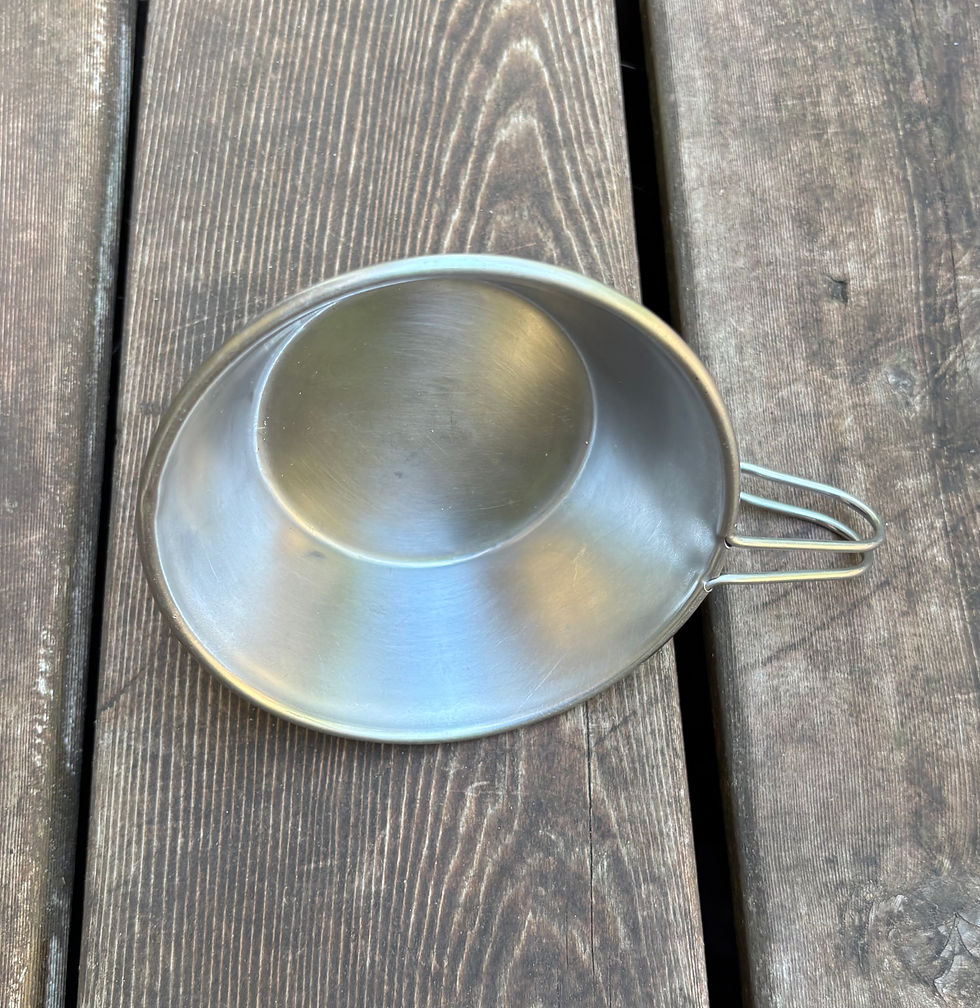

SIERRA CUP: The Sierra Cup was invented the early part of the 20th century and is one of a handful of camping products that has stood the test of time. Originally designed for collecting water from shallow streams, Sierra Cups are more like a small soup bowl or dipper than a cup. The Sierra Cup was never a great drinking cup, but it was a fine little bowl and a terrific ladle. The thick wire that circles the rim was said to keep the rim cool when sipping hot liquid. Sorry, it doesn’t! But the cup hangs nicely on a pot, water bucket or a hiker’s belt. It once signified that the owner was a “cup carrying member” of the Sierra Club.
Sierra Cups have largely been replaced by straight-walled, closed-handled mugs which are better drinking cups. But if you’re going light, nix the cereal bowl, teacup and ladle and get a Sierra Cup. Note: styles differ, but the original design (pictured above) is, in my opinion, the best.
------------------------
*My book CAMPING'S TOP SECRETS, 2022 revision, details practical camping tips and procedures that only the experts know. If you know just a few of these tricks, you'll be a hero to your friends!
*My teen book, JUSTIN CODY'S RACE TO SURVIVAL! mixes a fictional wilderness survival tale with practical outdoor tips everyone should know--a first for books of this type. Adults love it too! Now available as an audiobook!
NEW! Cliff Bookmark!

NEW! Cliff Bookplate


have followed during my time with scouting here in Minnesota and lucky enough to attend a couple of your preseentations during Northern Star's University of Scouting. I still have several of your books you signed and at 72 still refer to them when camping. Keep up the good work and writings. All the best and keep your tinder dry.